Sunday, 24 July 2011

A revolution comes unstuck

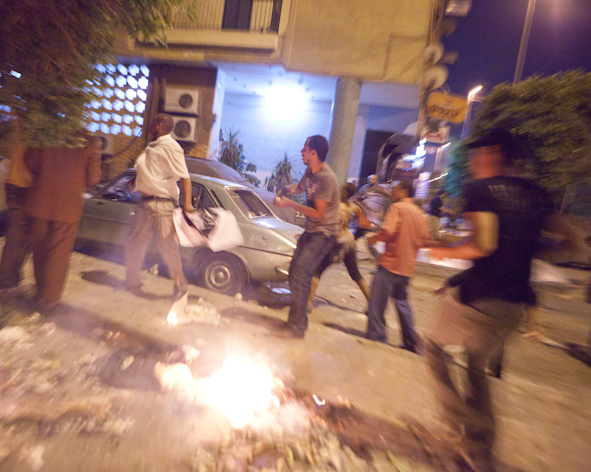
A pro-democracy protester faces off against angry residents in the Cairo neighbourhood of Abbasiyah


Egypt's revolution took a sorry turn on Saturday (July 23) night. Some thousand demonstrators left Tahrir Square and marched toward the headquarters of SCAF,  the military council currently not doing the greatest job in the world of governing post-Mubarak Egypt. The march was stopped by lines of soldiers behind barbed wire out side Noor Mosque in the neighbourhood of Abbasiyah. Around half an hour after the unstoppable force of the marchers met the immovable object of the military barricade, the inevitable occurred.  
I didn't see who threw what first, but soon enough the Tahrir crowd were embroiled in running street battles with local Abbasiyah residents, angered by the demonstrators' presence and apparently bolstered by the infamous 'baltigia' thugs. Rocks, bottles and bricks rained down from the surrounding rooftops and side streets as the Tahrir protestors responded in kind: trashing cars, store fronts and probably homes in the process. There may have been more protesters in Tahrir following the events of Saturday night than there had been for a while, but this seemed like no way to fix the waning popularity on the Jan 25th movement.  As a doctor spectating from the neighbouring hospital said to my colleague Remco Andersen of the Dutch paper Volkskrant for whom we were both on assignment in Egypt: "Egyptians fighting Egyptians. What a mess this has become."


Monday, 18 July 2011

Popping the cover cherry


So lil ol' me finally managed to get something printed on the cover of a magazine, which is nice. The subject, Othman Belbeisi, is just about one of the most interesting and genuine people you could hope to meet. After the 'shoot' he regaled me and my assistant-for-the-day  Naziha Baassiri over coffee and shisha with tales of the frankly crazy situations he faces on a near daily basis. As the head honcho of the International Organization for Migration in this neck of the woods, Othman is tasked with helping the region's domestic workers - possibly the most powerless of all the social strata in this part of the word -   get out of all kinds of scrapes, mostly  from escaping the clutches of crazy tyrants, be they Libyan 'Leaders' or Lebanese Madames. Anyway, JO's (a Jordanian magazine) own Cory Eldridge says it far better, see his story below, along with a nice nearly-candid shot I was able to take of Othman while enjoying his tales of derring do, an amazingly elderly grandfather and why Jordanian shishas are just better.


Sunday, 26 June 2011

The workers of Qatar


 These images were taken during a whistle-stop visit to Qatar last weekend, all (apart from the supermarket shot)  were taken inside residency compounds for migrant workers – mostly  Nepalese, Sri Lankan and Indian. These guys' attitude to my presence was by far the most accepting I've come across – a refreshing change from the usual ladles of suspicion heaped upon photographers. What I saw of their living conditions ranged from basic to downright disgusting; considering the profits being reaped by the development firms for which they ultimately work this situation is both unacceptable and unnecessary.


Wednesday, 8 June 2011

Salafis and strikes: Cairo


Egypt's Salafis are a conundrum. They resent their portrayal by Egyptian and Western media as
 bogeymen intent on taking over the world, then tell you that, in as much, this is exactly what they'd like to see happen.  The Salafis we met were very welcoming and certainly knew a thing or two about how to eat a sheep; rest assured, should a global caliphate arise it'll likely come with more good food than you can shake a Quoran at.  Intrepid reporter Sarah Lynch will have a far more insightful view on this whole situation in next month's Esquire Middle East and an insight into the economic effects of labour strikes in Egypt in next month's Executive.


Monday, 18 April 2011

Reasons to be cheerful

Refugees from the Lebanese community in Abidjan, the recently embattled Côte d'Ivoire city, arrived back in Beirut last Thursday.  The Lebanese have been in Côte d'Ivoire since the late 1800s and I can only imagine how hard it must be to leave your entire life behind you; there were some truly moving moments as families were reunited. Still, worried for their loved ones or not,  the guys waiting soon reverted to type as a MEA hostess (above) made her way out of the arrivals hall.


Sunday, 27 March 2011

Syrian strife spills into Lebanon

Given the fairly firm grip Syria still holds over Lebanon, it was only a matter of time before the unrest there found its way across the border. Today a number of Syrians in Beirut took to the streets in support of Bashar Assad's regime; two protests organised somewhat provocatively in strong Sunni areas saw violence - one demonstrator was shot in the stomach in a drive by shooting, at a second protest demonstrators were set upon by onlookers. I caught up with a around 150 protestors who were yelling Assad's praises outside the Syrian embassy. After around an hour they then proceeded to march all the way back to Dora, where they'd come from this morning.


Sunday, 20 March 2011

Lebanon's secular movement finds its stride


Exhaustive counting of the protestors who turned out today to mark their displeasure with Lebanon's sectarian malaise numbered roughly between 'rather a lot' and 'bloody loads'.  It's good to see this movement gaining momentum but sadly any viable alternative  to the confessional system of (mis)governance that has been slowly poisoning this country for far too many years seems far from clear.